The Definitive Guide to Industrial Pipe Fabrication: Process, Standards, and Strategic Maintenance
The Backbone of Modern Industrial Infrastructure
Modern industrial facilities rely on piping systems that function as their circulatory network, transporting liquids, gases, steam, and chemicals under extreme pressures and temperatures. Industrial pipe fabrication—and the specialized pipe fabrication services behind it—forms the backbone of this infrastructure.
Across the Southeast’s diverse industrial landscape, from poultry processing to petrochemical production, the demand for precision‑engineered piping is rising. At Hilton Mechanical Contractors (HMC), our “precision first” philosophy guides every project. Operating from our Gainesville and Alpharetta fabrication facility, we engineer systems built to withstand corrosive environments, thermal expansion, and high‑pressure service conditions.
A major part of this reliability comes from our ability to produce fully assembled pipe spools—pre‑fabricated sections of piping complete with fittings, flanges, and pipe supports—that streamline installation and reduce on‑site risk.
The 7 Critical Stages of the Pipe Fabrication Process
A disciplined, sequential workflow is essential for high‑integrity industrial piping. Each stage directly impacts system longevity and safety.
Material Selection: Carbon steel remains the industrial standard, but facilities handling corrosive media or steam often require stainless steel, duplex alloys, or copper for specialized applications. Petrochemical plants may demand exotic alloys for chemical resistance.
Pipe Cutting: Mechanical saws and plasma torches deliver precise cuts, ensuring each section fits perfectly when assembled into modular pipe spools.
End Preparation / Beveling: Clean bevels ensure proper weld penetration and long‑term structural integrity.
Fitting & Assembly: Pipes are aligned with elbows, tees, and flanges. During this stage, temporary pipe supports maintain alignment before tack welding.
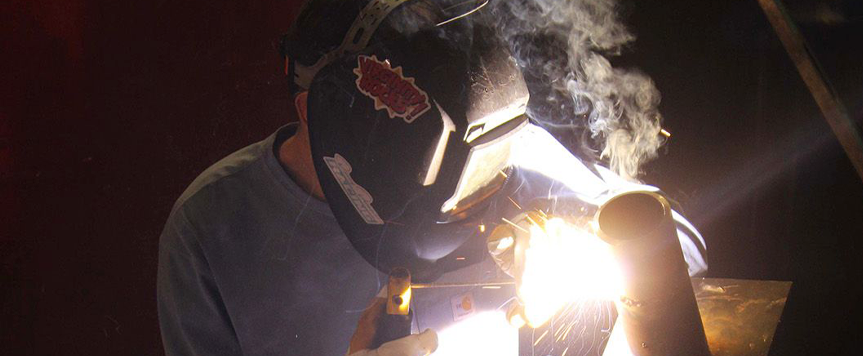
Welding (Multi‑Pass Process): Root, Hot, Fill, and Cap passes create a weld capable of withstanding high‑pressure service. TIG welding is often required for high‑purity or steam lines, while MIG and Flux‑Cored processes accelerate production for large‑diameter spools.
Inspection & Testing: NDT methods such as Radiographic Testing and Phased Array Ultrasonic Testing verify weld integrity inside the controlled environment of our fabrication facility.
Finishing & Coating: Industrial coatings, galvanization, and corrosion inhibitors protect piping systems used in chemical, food processing, and petrochemical environments.
Navigating Essential Codes & Standards (ASME & AWS)
Industrial piping is governed by strict codes due to the risks associated with high‑pressure systems:
ASME B31.3 – Process Piping (petrochemical, chemical, pharmaceutical)
ASME B31.1 – Power Piping (steam systems, heating/cooling plants)
ASME Section IX – Welding Qualifications
AWS D1.1 – Structural Steel & Pipe Supports
Prefabrication inside a climate‑controlled shop dramatically improves code compliance compared to unpredictable field conditions.
The Strategic Advantage: Shop Prefabrication vs. Field Assembly
The industry is rapidly shifting toward modular skid systems and pre‑assembled pipe spools. Field welding is vulnerable to weather, humidity, and site congestion—especially in Metro Atlanta’s dense construction market.
By contrast, HMC’s controlled fabrication facility environment allows:
– Higher weld repeatability
– Faster production of custom pipe spools
– Integration of pipe supports and structural components
– Reduced on‑site labor requirements
– Improved quality control for steam, hydronic, and chemical systems
This approach is especially valuable for data centers, food processing plants, and petrochemical facilities requiring precise, contamination‑free piping.
Industrial Pipe Maintenance: Maximizing Longevity & Performance
A high‑quality system is only as reliable as its maintenance program.
Advanced Inspections: PAUT identifies internal thinning or cracking before failure.
Mechanical Cleaning: Pigging and hydro‑jetting remove deposits that restrict flow in water, chemical, or steam lines.
Corrosion Protection: Coatings and inhibitors protect carbon steel, stainless steel, and copper piping from Southeast humidity.
Pressure Monitoring: Real‑time sensors detect anomalies early, preventing catastrophic failures in high‑pressure or petrochemical applications.
Precision and Reliability in the Southeast
High‑value industrial pipe fabrication requires engineering discipline, strict code adherence, and proactive maintenance. Hilton Mechanical Contractors delivers custom piping, modular skid systems, and precision‑built pipe spools engineered to perform in the Southeast’s most demanding industrial environments—from food processing to petrochemical production.
Our teams in Gainesville and Alpharetta stand ready to support your next project with industry‑leading pipe fabrication services and a commitment to doing it right the first time.