How Prefabricated Piping Can Reduce Industrial Construction Schedules
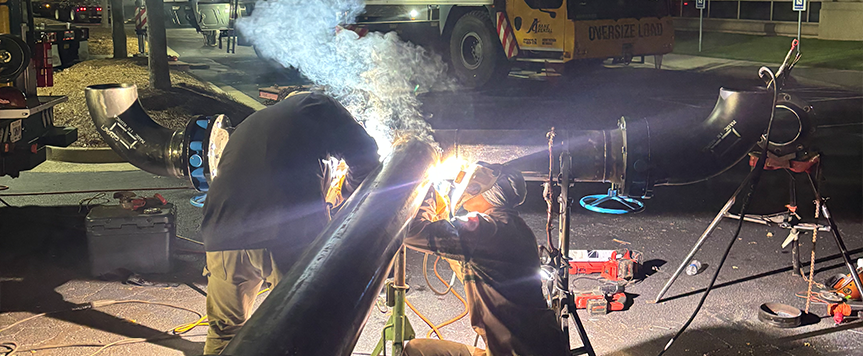
In industrial construction, schedule performance dictates profitability. This is especially true within complex, capital-intensive sectors such as oil and gas, refineries, power plants, and chemical plants. Delays in mechanical system installations, process piping alignment, or site integration create expensive ripple effects across a project, increasing overhead costs and postponing operational startup. Traditional field-fabricated piping (where cutting, fitting, welding, and inspection occur entirely on the job site) presents significant schedule bottlenecks. Field crews are exposed to unpredictable weather, tight spatial constraints, and crowded work areas, all of which hamper productivity.
To compress project timelines without sacrificing safety or quality, project managers and Engineering, Procurement, and Construction (EPC) teams rely on prefabricated piping and advanced pipe prefabrication strategies. By shifting pipe assembly from the construction site to a controlled off-site shop environment, industrial facilities can streamline critical paths, optimize labor usage, and shave weeks or even months off their overall construction schedules. Whether upgrading systems in power generation facilities or building highly regulated food processing plants, moving the workload off-site offers an undeniable competitive advantage.
What Is Prefabricated Piping?
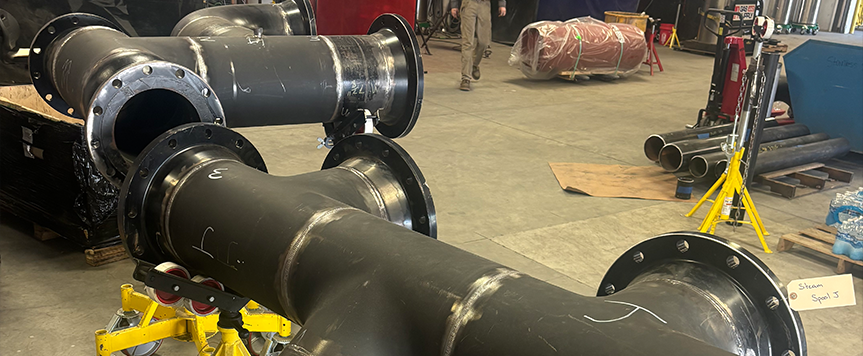
Prefabricated piping involves the off-site manufacturing of pipe spools, fittings, valves, and structural supports in a specialized fabrication shop before delivery to the construction site. Utilizing high-precision 3D models, such as Building Information Modeling (BIM) and Virtual Design and Construction (VDC), pipe fabrication experts construct prefabricated piping systems into manageable, pre-tested pipe sections.
This highly coordinated process includes assembling everything from intricate small-bore lines to large-diameter pipes, complete with all necessary elbows and flanges. Once fabricated, inspected, and surface-treated (painted or coated), these pipe spools are transported directly to the job site. Instead of assembling raw materials piece by piece in high-risk field environments, field teams lift, position, and connect ready-to-install units, drastically simplifying on-site installation.
5 Major Ways Prefabricated Piping Compresses Construction Timelines
1. Unlocking Parallel Workflows and Concurrent Construction
Under a traditional field-fabrication model, piping work is linear and heavily dependent on the progress of other trades. Civil teams must pour concrete, structural steel must be erected, and major equipment must be set in place before pipe fitters can measure, route, and weld piping.
Off-site fabrication breaks this linear dependency. While ground site preparation and structural work are underway in the field, pipe spools are simultaneously built in the fabrication shop. When the job site is structurally ready for mechanical work, the prefabricated pipe is delivered and ready for immediate placement. This parallel processing eliminates weeks of idle waiting time for piping crews and accelerates the overall field installation timeline.
2. Immunity to Weather Delays
Outdoor welding and fitting operations are inherently vulnerable to ambient environmental conditions. High humidity or rain introduces moisture into welds, causing porosity defects. Extreme cold requires time-consuming pre-heating procedures for base metals. High winds disrupt shielding gas coverage during GTAW (TIG) or GMAW (MIG) welding and can completely halt high-deposition methods such as submerged arc welding.
Shop-based pipe spool fabrication occurs inside a fully climate-controlled facility. Work continues on schedule regardless of rain, snow, or heatwaves, guaranteeing predictable daily output and steady progress toward critical milestone dates.
3. Maximizing Labor Productivity and Reducing Material Waste
Overcrowded job sites suffer from declining productivity due to trade interference, limited laydown space, and heightened safety hazards. Moving work to a fabrication shop minimizes the required on-site footprint and headcount.
Within a dedicated facility, specialized craftspeople utilize advanced automated machinery that cannot be easily deployed in the field. Working at ergonomically optimized stations significantly accelerates production compared to field crews welding from scaffolding or in tight crawl spaces. Furthermore, a controlled shop environment allows for precise inventory management and optimized cutting layouts, drastically reducing material waste compared to raw on-site fabrication.
4. Advanced Quality Assurance and Streamlined Testing
Field weld repairs are one of the leading causes of unplanned schedule delays in industrial construction. Rejecting a weld during on-site testing requires grinding out the defect, re-welding under suboptimal conditions, and retesting, a tedious process that halts surrounding work.
In a dedicated fabrication facility, strict quality control is integrated at every step. Specialized technicians perform non-destructive testing (NDT) such as X-ray, ultrasonic, and magnetic particle inspections under optimal lighting and conditions. Additionally, rigorous hydrostatic testing can be completed off-site to ensure structural integrity. Catching and resolving anomalies in the shop ensures that 100% compliant prefabricated piping reaches the field, virtually eliminating high-cost, schedule-draining field rework.
5. Rapid Field Rigging and Drop-in Assembly
Installing pre-assembled pipe spools shifts field operations from complex raw manufacturing to efficient final assembly. Rather than hoisting individual pipe lengths and components into place for tedious fit-ups aloft, crane operators lift complete spool assemblies directly into position. Field crews focus primarily on bolt-up connections or a minimal number of final field tie-in welds (pup pieces), reducing high-risk working hours at elevation and dramatically accelerating system handover.
The Role of 3D Models and VDC in Schedule Compression
The success of off-site piping fabrication relies heavily on accurate spatial planning. Advanced 3D models allow mechanical engineers to generate high-resolution digital twins of the entire piping network before a single piece of steel is cut.
By using 3D laser scanning of existing brownfield facilities or integrating VDC software into greenfield designs, engineering teams can detect spatial clashes (such as pipe runs intersecting structural beams or HVAC ducting) early in the design phase. This upfront accuracy guarantees that every component fits perfectly during installation, avoiding on-site modifications that disrupt construction milestones.
Partner with Hilton Mechanical for High-Efficiency Piping Projects
Compressing industrial construction schedules requires an experienced mechanical partner capable of executing complex pipe spool fabrication with uncompromising precision.
Hilton Mechanical brings deep industry expertise, cutting-edge fabrication technology, and certified craftsmanship to your industrial projects. Our state-of-the-art capabilities ensure your systems are engineered, built, tested, and delivered to exact specifications, keeping your project on schedule and within budget.
Our Industrial Piping Capabilities Include:
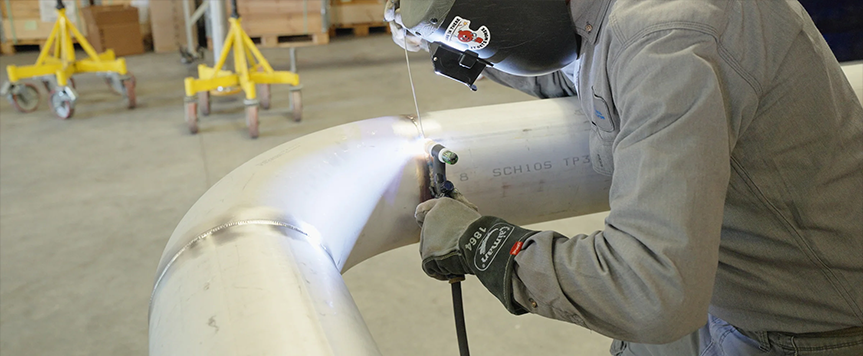
– Carbon steel, stainless steel, specialty alloys, and standard metal fabrication
– Full integration with spatial modeling and spool detailing for seamless installation
– Comprehensive non-destructive testing, hydrostatic testing, and strict quality control measures
– ASME code-compliant welding and quality management systems
– Just-in-time delivery coordination tailored to your exact job site schedule
Contact Hilton Mechanical today to discuss how our customized, off-site piping solutions can optimize your next construction timeline and improve your bottom line.